
Most E-2 visa investors expect the consular interview to be the hard part. It usually isn’t. The real work is the months of paperwork before it, where one document depends on another and small gaps turn into weeks of delay.
We built this map from three sources: the step-by-step process model behind INVISA’s ClarityPath tool, in-depth interviews with six E-2 visa holders, and official U.S. government guidance. It covers both franchise owners and independent business owners. Our model estimates about 6 to 7 months from first research to visa in hand, and about 9 months to the actual move. Every case is different, so treat all times here as directional estimates, not promises.
“I thought the hardest part would be the interview, but honestly, the real work was just preparing the documentation.” (Restaurant owner, E-2 since 2022)

Stage by stage E-2 paperwork map · 9 stages, 7 proofs
Stages 1 to 5 each create documents that flow into the E-2 package in stage 6. That is why a missing lease or bank record in stage 4 or 5 can hold up the whole filing.
The journey has eight stages before the visa, then a launch and a move. Several stages overlap, so the total is shorter than the sum of the parts. What you do in stages 2, 5 and 9 also depends on your path: a franchise, an independent business, or buying an existing business. The section “Franchise, independent or acquisition” below explains the differences.
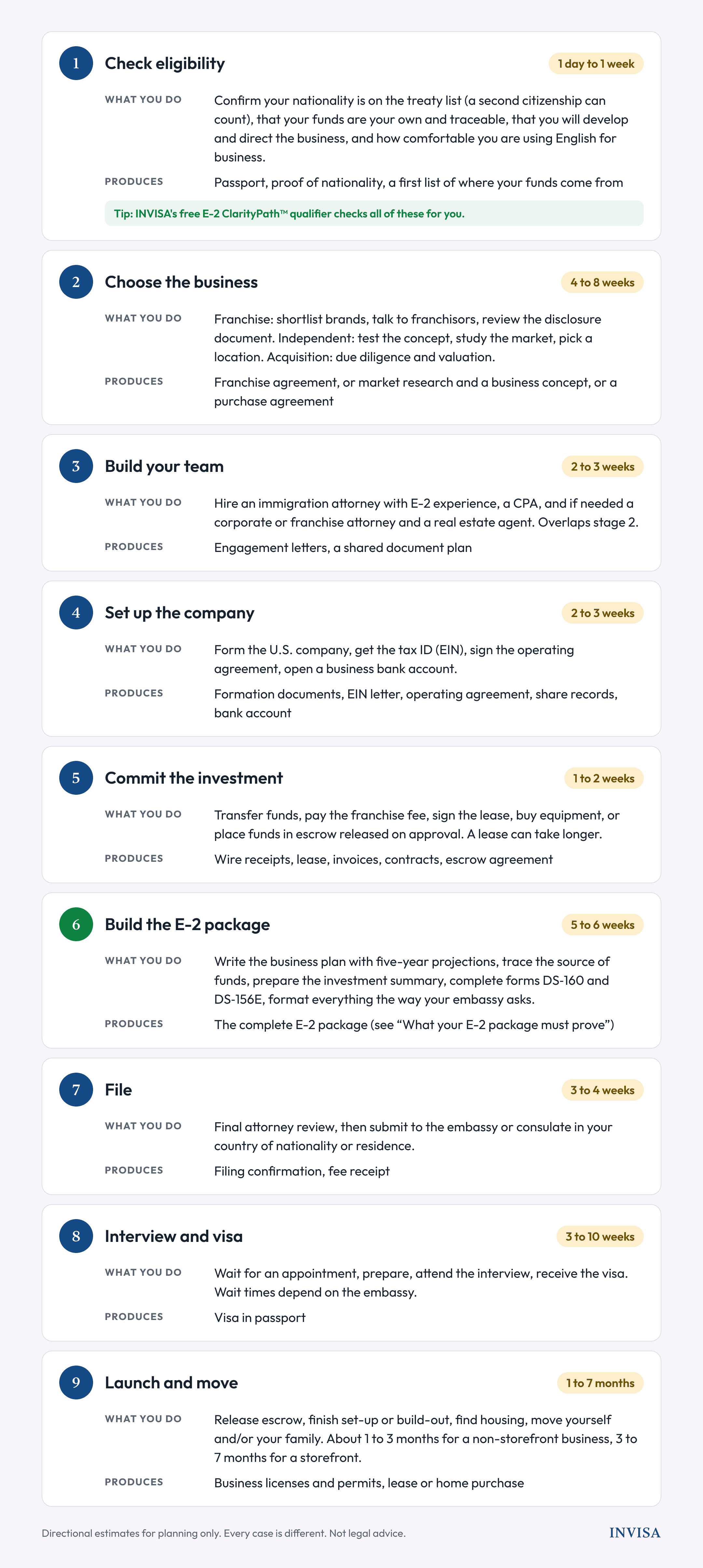
Times come from INVISA’s process model and are estimates. Embassy wait times change every month.
What your E-2 package must prove
The package has one job: to tell a single, consistent story that meets seven requirements. Most of its documents are created earlier in the journey, which is why the package can’t be rushed at the end.

There is no fixed minimum investment. Officers judge whether the amount is enough for the type and cost of the business, and USCIS notes a new business may take up to five years to earn more than a minimal living. Each embassy also sets its own rules for format, tabs, page limits and file size, so confirm your post’s instructions before you assemble anything.
Where investors lose time
None of the six investors we interviewed was refused. Still, most described small delays that added up. These five came up again and again.
One document leads to another. You need the company before you can open its bank account, and the bank account before you can show money moving into the business. Leases and contracts are usually signed in the company’s name, too. Asking for one item often uncovers the next requirement.
How to avoid it: map every document and what it depends on before you start. Begin with the items that unlock others: the company, the bank account and the lease.
The source-of-funds trail has gaps. Money that moved between accounts, came from a property sale years ago, or was a family gift must be traced from origin to the U.S. business account.
How to avoid it: collect statements and sale documents early, and write a short timeline of how the money moved.
No clear number for “enough.” With no fixed minimum, investors worry the amount is too low and keep adding evidence or capital.
How to avoid it: ask your attorney early what a strong investment looks like for your business type and cost. Build your investment summary around that.
Too many advisors, no single plan. Legal, tax and business pieces sit with different people, and every handoff adds back-and-forth.
How to avoid it: bring your immigration attorney in at stage 3, not stage 6, and keep one shared checklist that every advisor works from.
Starting too late. Every investor who gave advice said the same thing: start earlier than you think. Several needed months, not weeks, just to gather and organize records.
How to avoid it: count back from your target move date. If it is less than about nine months away, plan for a tight schedule.
Coming soon: Execution Flow. INVISA’s Execution Flow is being built to help with most of these steps in one place: a personal sequence of tasks, the documents each one needs, what depends on what, and milestones counted back from your target date. It will be part of INVISA’s paid plans.
“Sometimes one document would lead to another requirement or additional clarification. So the timeline wasn’t always the best.” (Consulting firm founder, E-2 since 2025)
Franchise, independent or acquisition: where the paths differ
The immigration steps are the same for everyone. The differences are in choosing the business type, proving the investment, what happens to your money if the visa is denied, and how long it takes to open.
Point | Franchise | Independent | Buying existing business |
|---|---|---|---|
Choosing the business | Shortlist brands, attend discovery days, review the franchise disclosure document | Test your own concept, research the market, often build on past experience | Find a business for sale, check its books, value it and negotiate the price |
Extra advisor | Franchise attorney, sometimes a franchise broker | Business-plan consultant, sometimes an industry mentor | Business broker, plus an attorney and CPA for due diligence |
Proof of investment | Franchise fee and franchisor’s cost estimates give a ready structure | You build the investment summary yourself from quotes, invoices and the lease | Purchase agreement, closing documents and proof of payment |
Business plan | Franchisor data helps, but the plan must still be your own | Built from scratch, so market research carries more weight | Built on the business’s past financial statements and tax returns, plus your growth plan |
If the visa is denied | Many franchisors let you hold the franchise fee in escrow, so it can be returned, at least in part. Check your franchise agreement | Lease, build-out and equipment are usually paid before filing, so this money is harder to recover | The purchase price is often held in escrow, and the sale is made conditional on the visa |
Typical opening time after the visa | Depends on the brand’s training and build-out schedule | 1 to 3 months for services, 3 to 7 months for a storefront such as a restaurant | Often already operating, so you take over at closing |
In our interviews, five of six investors built an independent business. Most built it on skills or industry experience they already had.
After the visa: launch, move and keep your status
The visa opens the door, but two more tracks run at the same time: opening the business and moving yourself and/or your family.
Escrow and launch. If your funds sit in escrow, they are usually released when the visa is issued. Training, build-out and opening start then.
Relocation. Housing search, lease or purchase, and the move itself take about two months in our model. Start planning before the interview, not after.
Family. Your spouse and unmarried children under 21 can come with you. Since January 2022, an E-2 spouse can work as soon as they arrive, with an I-94 record marked E-2S. A separate work permit is optional.
Validity. E-2 visa validity is up to 60 months but it varies by nationality and can be renewed indefinitely. Renewals look at how the business is actually doing, so keep payroll, tax returns and contracts organized from day one.
Two recent changes to know:
Since September 2, 2025, most E visa class applicants, including people renewing, must attend an in-person interview.
Since September 6, 2025, the U.S. State Department expects applicants to apply in their country of nationality or residence. Applying in a third country can lead to more refusals.
Start this month
Five steps that save the most time later:
☐ Confirm your treaty nationality, including any second citizenship. Our free E-2 ClarityPath qualifier (coming soon) will check this and your other key eligibility points in a few minutes. [Link coming soon]
☐ Write a one-page timeline of where your investment money came from, and start collecting the statements that prove it.
☐ Pick a target move date and count back about nine months. Our free E-2 Timeline Planner, coming soon, will do the math for you and show both tracks: immigration and business launch.
☐ Talk to an E-2 immigration attorney early, before you sign a lease or pay a franchise fee.
☐ Look up your embassy’s E visa instructions and wait times, so you know its format rules from the start.
About this article
How we built it. The stages and time estimates come from INVISA’s E-2 process model, the sequence behind ClarityPath, prepared in 2026. We refined it with six in-depth interviews with E-2 visa holders from five treaty countries (August to September 2026) and with official guidance from the U.S. Department of State and USCIS. Interview quotes are lightly edited for clarity.
Please note. This article is general, educational information, not legal advice. Requirements, fees and wait times change and differ by embassy. All times are estimates for planning. Before you commit money or file, confirm the details for your case with a qualified immigration attorney.
Sources:
Treaty Trader & Treaty Investor Visa (E), U.S. Department of State
E-2 Treaty Investors, USCIS
Global Visa Wait Times, U.S. Department of State
Visa applicants must apply in country of citizenship or residence, Boston University ISSO (Sept 2025)
The visa interview waiver process drastically narrowed, CILG (Sept 2025)
E-2 visa supporting documents guide, NNU Immigration
What to include in your E-2 submission, Legal Services Inc.
Escrow for E-2 investment funds, LegalClarity


